 Milan Nel Cuore
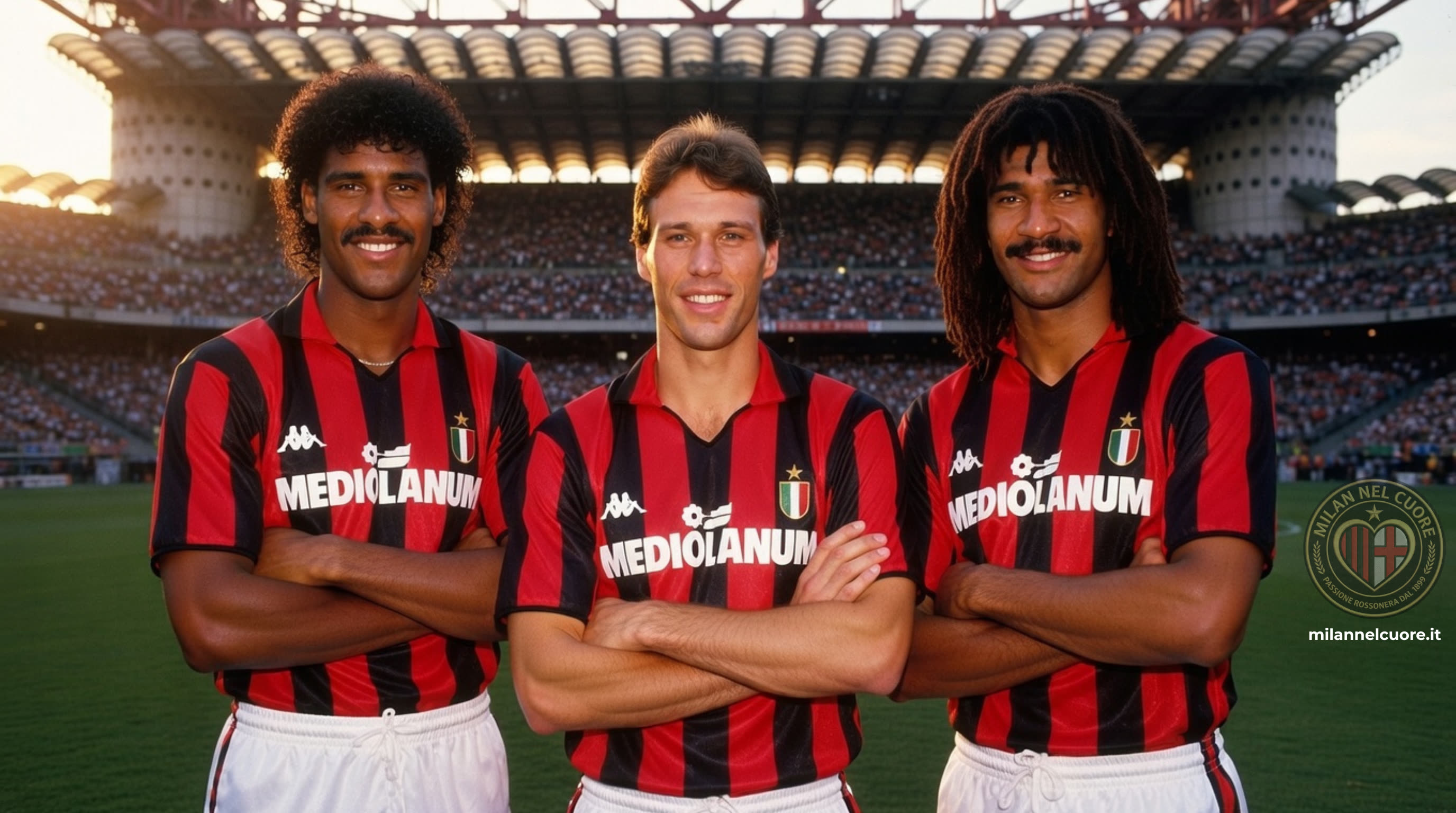
In the history of football, there are moments when everything changes. For AC Milan, that moment has a precise year — 1987 — and three names that still make every Rossoneri fan’s heart beat faster: Ruud Gullit, Marco van Basten and Frank Rijkaard. The Dutch trio, nicknamed the “Three Tulips” by the Italian press, did not merely win trophies: they redefined the very essence of the game, transforming Sacchi’s Milan into the most admired and feared club in Europe. This is their story.
The summer that changed everything: Gullit and Van Basten arrive in Milan
The arrival of the Dutch trio at Milan did not happen in a single transfer window, but over two consecutive summers that rewrote the hierarchy of European football. In 1987, Silvio Berlusconi — president since February 1986 — decided to invest heavily in Dutch talent to restore the Rossoneri to the top after years of decline, relegation and betting scandals.
The first signing was Ruud Gullit, lured from PSV Eindhoven for a then world-record fee of around 13.5 billion Italian lire. The “Black Tulip” — a nickname that would follow him throughout his Milan career — arrived as the reigning 1987 Ballon d’Or winner. Tall, powerful, technically gifted and charismatic, Gullit was a one-of-a-kind player: equally comfortable as a midfielder, playmaker or striker.
Alongside him, Marco van Basten arrived from Ajax. The “Swan of Utrecht” was just 22 years old, but had already demonstrated extraordinary talent in the Netherlands: right foot, left foot, headers and acrobatic volleys that defied gravity. At Milan he would score 124 goals in 201 appearances, numbers that still make him one of the greatest strikers in the club’s history.
The final piece of the puzzle arrived the following summer. In 1988, from Sporting CP (where he had been registered too late for European competition and was loaned to Real Zaragoza, enduring a disappointing season plagued by injuries and few appearances), Frank Rijkaard finally landed at Milanello. A complete midfielder — elegant, intelligent and tactically astute — Rijkaard was the player needed to complete the Dutch mosaic. In Rossoneri colours he would amass 201 appearances and 26 goals across five seasons.
Sacchi’s Milan: the tactical revolution
The three Tulips alone would not have been enough. They needed a visionary coach capable of maximising their qualities within a collective project. That man was Arrigo Sacchi, who arrived on the Milan bench in July 1987 straight from Parma in Serie B.
Sacchi brought ideas that were revolutionary for Italian football at the time: high pressing, zonal defending without a sweeper, an extremely high defensive line and an attacking style built on possession and constant movement. Sacchi’s Milan did not sit back and wait for opponents: they hounded them, suffocated them and forced them into mistakes. It was total football, descended from the Dutch school of Rinus Michels and Johan Cruyff, but taken to a level of tactical perfection never before seen in Italy.
The three Dutchmen were the pillars of this system. Gullit operated as a second striker or playmaker, free to roam across the entire front line. Van Basten was the central reference point, the lethal finisher. Rijkaard governed the midfield with vision, perfectly timed runs and a defensive solidity that allowed his teammates to take risks. Around them, players such as Franco Baresi, Paolo Maldini, Mauro Tassotti, Alessandro Costacurta, Carlo Ancelotti and Roberto Donadoni completed what many regard as the greatest club side of all time.
The revolution in numbers
In the 1987/88 season, Sacchi’s Milan conceded just 14 goals in Serie A: the best defence in the league. A remarkable figure for a side that played attacking football with the defensive line pushed up to the halfway line.
The 1988 Scudetto: Milan are great again
The first season together produced immediate results. Milan won the 1987/88 Scudetto, their first league title in nine years, overhauling Diego Maradona’s Napoli. Gullit finished the season with 9 league goals, dragging the team forward with dominant performances. Van Basten, despite a slow start as he adapted to Italian football, exploded in the second half of the campaign and became unstoppable.
That title was not just a trophy: it was a statement of intent from a Milan side with their sights firmly set on conquering Europe. And Europe, before long, would be brought to its knees.
Milan 5–0 Real Madrid: the night that shook the world
If one match encapsulates the essence of Sacchi’s Milan and the Dutch trio, it is the European Cup semi-final second leg against Real Madrid, played at San Siro on 19 April 1989. A night that entered legend.
In the first leg at the Santiago Bernabéu, Milan had earned a 1–1 draw thanks to a Van Basten goal that cancelled out Hugo Sánchez’s opener. In the return, before a packed San Siro, something extraordinary unfolded.
Milan demolished Real Madrid 5–0. Five goals, five masterpieces. Carlo Ancelotti opened the scoring on 18 minutes with a Gullit assist. Then Rijkaard on 25, Gullit on 45, Van Basten on 49 and Donadoni on 59. All three Dutchmen on the scoresheet in a flawless display. Real Madrid — with Hugo Sánchez, Butragueño and Michel — were utterly overwhelmed by the Rossoneri storm.
The aggregate scoreline read 6–1. It was the heaviest defeat Real Madrid had ever suffered in European competition. Arrigo Sacchi declared: “Tonight we played the perfect match. Not a game — a work of art.”
Milan 4–0 Steaua: the first European Cup
After that dream semi-final, Milan flew to Barcelona for the 1988/89 European Cup final against Steaua Bucharest. On 24 May 1989, at the Camp Nou, the Rossoneri delivered another perfect performance.
Gullit opened the scoring on 18 minutes, capitalising on a fumble by Romanian goalkeeper Lung. Ten minutes later, Van Basten doubled the lead with a header from a Tassotti cross. Before half-time, Gullit made it 3–0 with an exquisite first-time finish. In the second half, barely a minute after the restart, Van Basten sealed the rout with a diagonal shot set up by Rijkaard.
Milan 4–0 Steaua. A brace each for Gullit and Van Basten, a decisive assist from Rijkaard. The three Dutchmen were the undisputed stars of the evening, handing Milan their third European Cup after those of 1963 and 1969. At the Camp Nou, over 90,000 spectators — the vast majority Milanisti — witnessed a display of power that the European press called “the perfect match by the perfect team.”
Milan 1–0 Benfica 1990: the European double sealed by Rijkaard
If the 1989 final spotlight belonged to Gullit and Van Basten, the 1989/90 European Cup reserved the stage for the third Dutchman. On 23 May 1990, at the Prater Stadium in Vienna, Milan faced Benfica in the final.
The match was very different from the Barcelona goal-fest: more tactical, more tightly contested, more tense. The first half ended 0–0 with few clear chances for either side. But on 67 minutes the decisive moment arrived. Van Basten threaded a perfect through ball for Rijkaard, who bore down on goal and beat the Portuguese goalkeeper with composure. Milan 1–0 Benfica: the most important goal of Frank Rijkaard’s career.
Milan became the first club to win back-to-back European Cups since Brian Clough’s Nottingham Forest (1979 and 1980). An achievement that definitively consecrated the Dutch trio and Sacchi’s Milan as one of the greatest teams in football history.
The Dutch trio in numbers
Statistics only tell part of the story, but in the case of Gullit, Van Basten and Rijkaard, the numbers carry enormous weight.
Ruud Gullit — nicknamed the “Black Tulip” for his elegance and unmistakable dreadlocks — wore the Rossoneri shirt from 1987 to 1994, racking up 171 appearances and 56 goals. With Milan he won 3 Serie A titles (1988, 1992, 1993), 2 European Cups (1989, 1990), 2 European Super Cups, 2 Intercontinental Cups and 3 Italian Super Cups.
Marco van Basten played for Milan from 1987 to 1995, although his last match dates back to 26 May 1993 due to the ankle injuries that prematurely ended his career. In 201 appearances he scored 124 goals, claiming 3 Ballons d’Or (1988, 1989, 1992), three league titles, two European Cups and every other trophy of the Rossoneri golden age.
Frank Rijkaard was the least flashy of the three, yet arguably the most indispensable in tactical terms. From 1988 to 1993 he accumulated 201 appearances and 26 goals — impressive numbers for a midfielder. It was he who scored the winning goal in the 1990 European Cup final, and his presence in midfield guaranteed balance and cover under both Sacchi and his successor Fabio Capello.
The twilight of the Three Tulips
Like all great stories, the tale of the Dutch trio at Milan had an ending. And it was an ending dictated by the cruelty of injuries rather than tactical decisions.
Rijkaard was the first to leave. In the summer of 1993 he returned to Ajax, the club that had raised him, completing the circle of an extraordinary career. In Amsterdam he would enjoy one last successful season before retiring.
Van Basten played his final match on 26 May 1993, in the Champions League final lost 1–0 to Marseille in Munich. His right ankle, operated on four times, would never allow him to play again. On 17 August 1995, aged just 30, he announced his retirement from football at a press conference that moved the entire sporting world. The following day, during the Trofeo Berlusconi, he walked around the San Siro pitch to bid farewell to the fans who had adored him. It was the saddest goodbye in Rossoneri history.
Gullit left Milan in 1994 after an increasingly strained relationship with Fabio Capello, Sacchi’s successor. He moved to Sampdoria and then to Chelsea, where he continued to enchant with his spectacular football.
The eternal legacy of the three Dutchmen
Almost forty years on, the legacy left by Gullit, Van Basten and Rijkaard at Milan and in world football remains immense. Pep Guardiola, Jürgen Klopp, Ralf Rangnick and Diego Simeone have all declared that they studied that Milan side to build their own football philosophies. The high press, the compact defensive line and the collective attacking play that we now take for granted were born in those unrepeatable seasons at Milanello.
The three Dutchmen were not simply great players: they were the symbol of an era when Milan were the strongest, most beautiful and most innovative club on the planet. Every time a Rossonero fan speaks about that period, a special light flickers in their eyes. Because Gullit, Van Basten and Rijkaard did not just win — they made people fall in love with the game.
Two consecutive European Cups, three Serie A titles, three Ballons d’Or for Van Basten and one for Gullit. But above all, a style of football that changed history forever. The Three Tulips of Milan remain the highest peak ever reached by club football. And at San Siro, when the wind blows on European nights, you can still hear the echo of those goals and that applause.
Forza Milan, sempre.