 Milan Nel Cuore
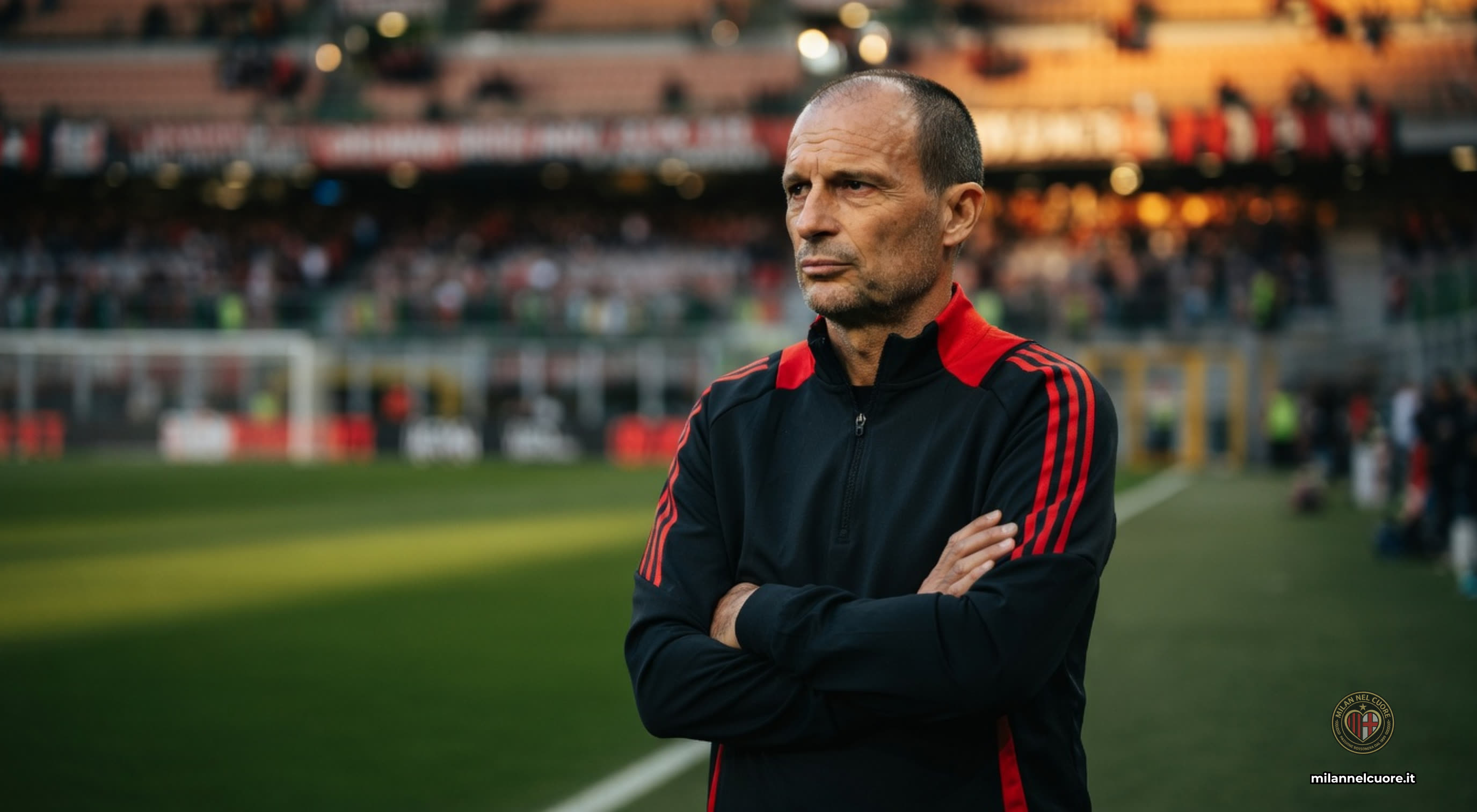
AC Milan are in the eye of a storm. Three defeats in their last four games, a San Siro crowd that has turned on Rafael Leao, a Serie A table that suddenly feels fragile and Champions League qualification that is no longer guaranteed. And yet, in the darkest stretch of the season, Massimiliano Allegri is trying to steady the ship with two parallel moves: one for the present — a return to the 3-5-2 at Verona with Matteo Gabbia back in the starting XI — and one for the future, an explicit list of ten untouchable players around whom the 2026-27 squad will be rebuilt. The board, meanwhile, has publicly backed the head coach and shut down any talk of a sacking.
A dark patch: three defeats in four matches
The last four matchdays tell a brutal story: a home defeat to Lazio, a proud 3-2 comeback win against Torino, the Easter Monday loss at the Stadio Diego Armando Maradona against Antonio Conte's Napoli (a 1-0 settled by Politano) and then the disaster of last Saturday, Milan 0-3 Udinese, a Bartesaghi own goal, an Ekkelenkamp header and a clinical Atta finish. Three defeats and only one win in the last four fixtures — three losses different in how they unfolded but identical in the message they send. Something is broken.
The worst moment came in the stands. When Leao was substituted on 77 minutes against Udinese, San Siro booed him off in a way not heard for years. Allegri hugged him as he left the pitch, but the crowd's verdict was unmistakable. Champions League qualification, which looked locked in a month ago, has suddenly turned into an open question: according to Opta's simulations, Milan still have an 85% chance of finishing in the top four, but the margin for error is razor-thin. Juventus are just three points behind, Como are five, and the Bianconeri visit San Siro the week after Verona.
Allegri's formation change: why Milan are back to the 3-5-2
The 4-3-3 experiment with Leao as the central striker had a logic on paper: shift the attacking balance, free the Portuguese from the flank, create density in the final third. On the pitch, the reality was different. Against Udinese, Milan produced their worst performance of the season — an overrun midfield, a disorganised back line and a toothless attack. Allegri has seen enough. At the Bentegodi on Sunday 19 April, for Matchday 33 of Serie A, the Rossoneri will revert to the 3-5-2.
The switch is not a full rejection of the 4-3-3, just an acknowledgement of the moment. The Livornese manager explained it with one of his trademark one-liners: “It's a rough patch, but the formation change is not the reason”. Speaking to DAZN before the Udinese disaster, he had already warned: “We can't let events overwhelm us, let's hope we picked the right lineup.” Read today, those words sound like an implicit admission: the 4-3-3 was a gamble, the 3-5-2 remains the team's safest baseline. Returning to a back three when the side desperately needs certainty is the most logical call to stop the bleeding.
Gabbia back in the XI: the numbers that prove it matters
Tactics, however, are not the biggest story of the week. That honour belongs to Matteo Gabbia, who returned to full training on 7 April after 44 days on the sidelines. The 1999-born centre-back had not played since 18 February — his last appearance was against Como — before undergoing surgery for an inguinal hernia. In the seven games he missed, Milan lost a significant chunk of their defensive certainties — and the numbers prove it better than any narrative.
The data is unforgiving. In the 25 matches with Gabbia on the pitch, Milan conceded just 19 goals, an average of 0.76 per game. Without him, the defence has collapsed: in seven games without Gabbia, the Rossoneri shipped 8 goals, a full 1.14 per game. Even more telling: with Gabbia in the starting XI, Milan put together a 25-match unbeaten league run — a streak broken precisely by his absence. The absence overlaps with almost every recent disaster, his presence with a Milan that looks compact, organised and genuinely hard to beat.
At the Bentegodi, Gabbia will slot back into the middle of the back three alongside Fikayo Tomori and Strahinja Pavlovic, taking the place of Koni De Winter. More than a return, this is a homecoming: Allegri is leaning on the dressing room's quietest leader, the one player whose on-field habits tilt the whole defensive balance. To prepare the trip, Allegri has cut one of the two planned days off and called the squad back to Milanello on Monday, with sporting director Igli Tare present at training.
The board backs Allegri: no sack, project confirmed
In another club, three defeats in four games would have opened a debate about the manager. Not at Casa Milan. Sporting director Igli Tare, CEO Giorgio Furlani and Zlatan Ibrahimovic have all quietly reaffirmed their trust in Allegri. No emergency meeting, no veiled warning, no short-term sacking scenario on the table. The Livornese coach remains the architect of the 2026-27 project and will still be in charge next season whatever happens between now and 24 May.
The board's stance is rooted in a clear logic. Allegri arrived last summer with a specific mandate: restore stability to an environment that, over the previous two years, had seen three different head coaches, a reshaped technical department and a scattered transfer strategy. Pulling the trigger now would mean resetting the cycle all over again, losing months and scrapping a technical framework that has only just been built. The board knows this and has chosen to defend the manager even as parts of the fanbase turn restless. It is the Cardinale line: continuity, patience, long-term thinking.
The 10 untouchables for 2026-27: Allegri's full list
Continuity is also the key to the other major story coming out of Milanello this week: the list of ten untouchable players Allegri wants to keep at all costs to build his 2026-27 AC Milan. These are the names the club will refuse to sell, even for substantial offers, because they represent the technical and human backbone of next season.
The 10 untouchables
Goalkeepers: Mike Maignan (contract extended until 2031) and Pietro Terracciano, a reliable number two.
Defence: Strahinja Pavlovic, having a record-breaking season including on the scoresheet; Matteo Gabbia, the silent leader of the back line; Koni De Winter, Gabbia's natural partner; Davide Bartesaghi, who has gone from Milan Futuro to first-choice left-back in a year; Zachary Athekame, a tactical weapon Allegri considers essential for his formation switches.
Midfield: Adrien Rabiot, the on-pitch symbol of the Allegri philosophy.
Attack: Alexis Saelemaekers (contract extended until 2031), a versatile player Allegri trusts implicitly; Christian Pulisic, the attacking reference point around whom the new front line will be built.
The list is just as interesting for the names it does not include. The biggest omission is Rafael Leao: the Portuguese is outside the Allegri project and his agent is reportedly already exploring new destinations. The same applies to Christopher Nkunku, a €42m signing last summer now openly on the market. Also excluded: Santiago Gimenez, Ruben Loftus-Cheek, Youssouf Fofana, Alex Jimenez and Luka Jovic. This is a full-scale rebuild, guided by one criterion: keep only the players Allegri considers a fit for his football and his dressing room, sell the rest to fund next summer's signings.
A note on Luka Modric: the Croatian, signed last summer to mentor the new-look midfield, does not formally appear in the list of ten because his future is tied to factors beyond the coach's control. Allegri rates him highly and sees him as a pillar of the dressing room, but any extension for the 40-year-old former Real Madrid captain will be handled as a separate conversation, weighing his physical condition and his own willingness to carry on.
Towards Verona-Milan: an unbeaten streak to defend since 2017
The first real test for the reborn 3-5-2 and for Gabbia's comeback comes at the Bentegodi on Sunday 19 April 2026, Matchday 33 of Serie A. On paper an approachable trip, in reality a high-stakes fixture: seven days later Juventus arrive at San Siro just three points behind, and another slip-up would open a scenario that was unthinkable a month ago.
There is, however, one statistic that can serve as an anchor in a stormy week. Milan have not lost to Hellas Verona in Serie A for ten consecutive fixtures: the last non-win was the 2-2 draw at San Siro on 8 November 2020. Since then, ten matches and ten Rossoneri victories. The picture at the Bentegodi is even more striking: the last five trips to Verona have all ended in a Milan win, with 11 goals scored and just 3 conceded. The last Rossoneri defeat on Hellas Verona's pitch in Serie A dates back to 17 December 2017, when the home side ran out 3-0 winners: that makes it more than eight years of unbeaten league football at the Bentegodi.
It is a stat that carries weight. On 19 April, Milan travel to Verona with the pressure of a crisis on their shoulders — but also with a recent history that says this venue has been kind. Allegri will cling to everything: the rediscovered 3-5-2, Gabbia's return, the board's unconditional backing, the ten-untouchables list as a manifesto of intent — and an unbeaten run that has stretched since 2017 and simply cannot end right now.
Milan cannot afford another misstep. But for the first time in weeks they have something that had started to disappear: a plan. A formation to hold on to, a leader coming back, a board that has not flinched, a core group of players to rebuild around. Verona is the first test. Everything else follows.
Forza Milan, always.