 Milan Nel Cuore
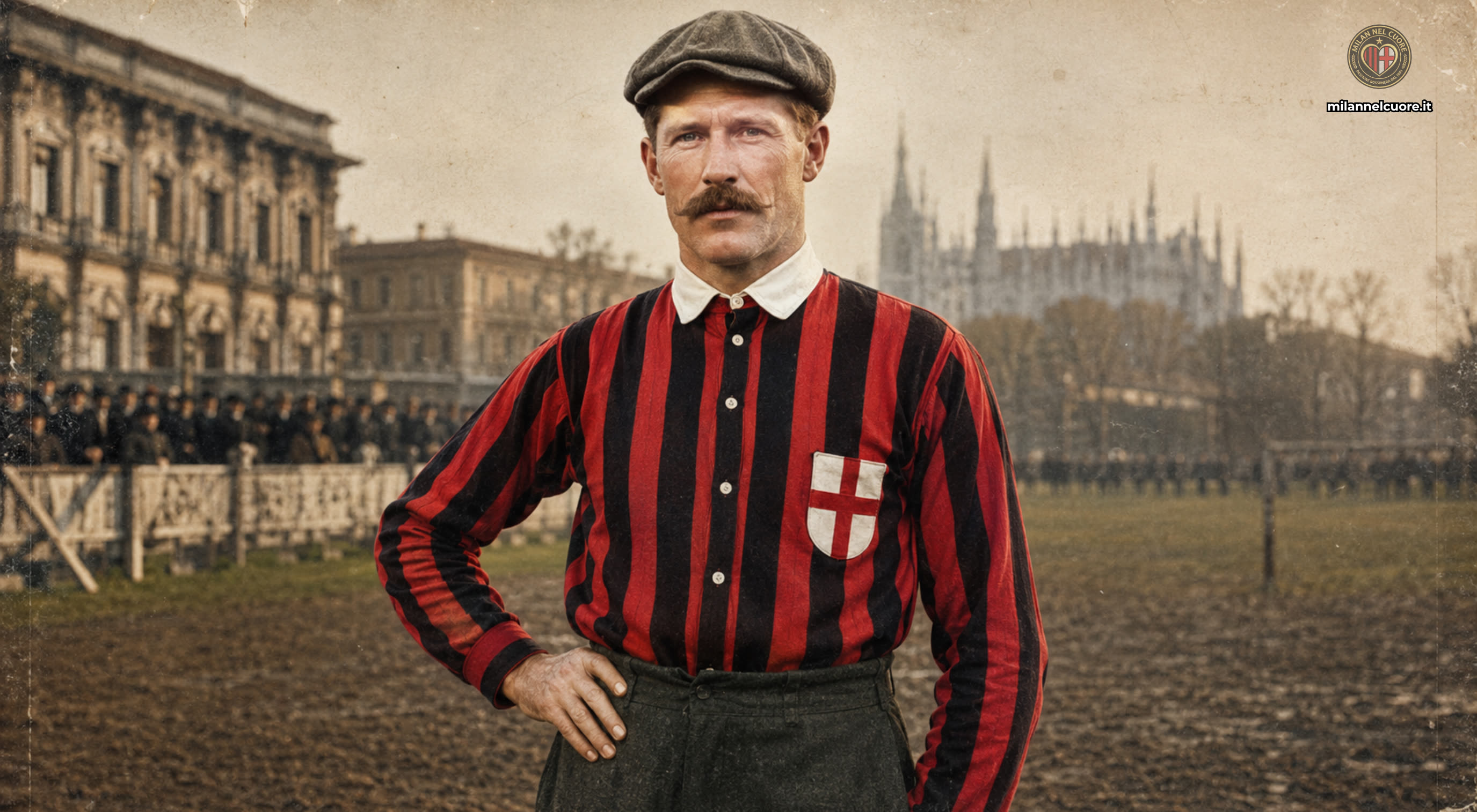
Every great story has a beginning, and the story of AC Milan begins on a cold December afternoon in 1899, inside a hotel in the heart of Milan, around a table where a group of Englishmen and Italians decided to create a football and cricket club. Among them was a young textile merchant from Nottingham, a slim man with a thick handlebar moustache and an intense gaze: Herbert Kilpin. That evening the Milan Foot-Ball and Cricket Club was born, and with it the red-and-black shirt that would later collect nineteen Italian league titles, seven European Cups and a place among the most beloved football institutions in the world. This is the story of an Englishman who gave AC Milan its heart, its name and its colours.
From Nottingham to Milan: the man behind the foundation
Herbert Kilpin was born in Nottingham, England, on 24 January 1870, in a house at 129 Mansfield Road (later renumbered 191). The son of a butcher and the youngest of a large family with nine older siblings, he left school early and found work as an assistant in a lace warehouse — one of the staple industries of late-Victorian Nottingham.
As a teenager he fell in love with football, the sport that in those very years was beginning to spread from the English public schools to the European continent. He played as an amateur in his hometown, but fate had a far longer journey in store for him: in 1891, at just 21 years of age, he moved to Italy to work in the textile industry in Turin.
In the Piedmontese capital he immediately combined work and passion, signing for Internazionale Torino, considered by many historians the very first proper football club founded in Italy. During his years in Turin he also won three regional titles and became one of the pioneers of a sport that Italians still treated with a kind of curious reverence, calling it simply "foot-ball".
A life between England and Italy
Kilpin was not a professional footballer in the modern sense. He was a textile merchant who happened to love football above all else: he imported the game into Italy with the same natural ease with which he imported cotton and wool from England. His was an all-consuming passion that would follow him from his first kicks in Nottingham to his final seasons in Milan.
In 1898 Kilpin moved to Milan for work. Lombardy's capital, in the middle of its industrial boom, was the economic heart of a still-young Kingdom of Italy. Here Kilpin found a small group of fellow countrymen — merchants, engineers and managers — who shared his enthusiasm for football. All that was missing was the right occasion to turn that passion into something lasting. It came only a few months later, in a room inside one of the city's most fashionable hotels.
16 December 1899: the birth of the Milan Foot-Ball and Cricket Club
The official date celebrated by the club is 16 December 1899, although some historians believe the founding assembly actually took place two days later, on 18 December. The original charter of the club was lost, making it impossible to settle the question with absolute certainty, but Rossoneri tradition still celebrates 16 December as the official birthday.
The founding meeting took place at the Hotel du Nord et des Anglais in Milan, an elegant hotel frequented by the British community in the city. Around the table sat several Englishmen living in Milan, joined by a small group of Italians interested in the new sport that was just beginning to take root in Italy. A few days earlier, according to the most reliable reconstruction, Kilpin, Samuel Davies and David Allison had met Alfred Edwards at the Fiaschetteria Toscana on Via Berchet, a wine tavern where the idea of creating a proper sporting club had first been discussed.
The name chosen for the new club was Milan Foot-Ball and Cricket Club, written rigorously in English. That choice was not accidental: it reflected the Anglo-Saxon roots of the sport and the cultural prestige that England exerted across all of Europe at the time. Even the name of the city was anglicised into "Milan", a spelling destined to survive to the present day and to become one of the most recognisable sporting brands in the world.
From the very beginning the club was conceived as a multi-sport society: it included a cricket section, run by Edward Nathan Berra, and a football section, captained by David Allison and coached by Herbert Kilpin, who also served as second captain. Only in the years that followed did football take over completely, leaving cricket as a marginal chapter in a story that would become entirely Rossoneri.
The first official headquarters of the club were set up at the Fiaschetteria Toscana, at number 1 of Via Berchet, a short walk from the Galleria Vittorio Emanuele II. The administrative heart of the young club would beat in that tavern for the next ten years, until 1909, when the offices were moved to the Birreria Spatenbrau on Via Ugo Foscolo. The first home ground was the Trotter in Piazza Doria, the area where Milan's Central Station would later be built.
Alfred Edwards and the founding fathers
It is tempting to remember Kilpin as the sole founder of AC Milan, but the historical truth is richer and more collective. The first elected president was Alfred Ormond Edwards, already vice-consul of the United Kingdom in Milan, a respected businessman and a key bridge between the British community and the Milanese bourgeoisie. Edwards gave the club his social prestige and a vital network of contacts during its earliest years.
Alongside Edwards and Kilpin sat other pioneers whose names deserve to be remembered: Edward Nathan Berra as vice-president and head of the cricket section, Samuel Richard Davies as secretary and the aforementioned David Allison as football captain. To them were added Daniele Angeloni, Giannino Camperio, Antonio Dubini and Guido Valerio, Italians whose presence from day one underlined the international, cosmopolitan character of the new club.
The first official match in AC Milan's history was played on 15 April 1900 at the Velodromo Umberto I in Turin. The opponents were Torinese, one of the most established sides in Italian football at the time. The result was not memorable on the pitch — Milan lost 3-0 — but it represented the competitive birth of the club. From that afternoon in Piedmont, the Rossoneri story was officially under way.
Red and black: the story behind the Rossoneri colours
Few sporting symbols are as iconic as the red-and-black shirt, and few owe so much to their creator. The choice of the colours that would accompany AC Milan through more than a century of triumphs belonged to Herbert Kilpin, and the reason he gave for that choice has gone down in club legend.
Kilpin's quote on the colours
"We will be a team of devils. Our colours will be red like fire and black like the fear we will invoke in our opponents."
From that moment AC Milan became, forever, the Devils. The first kits were heavy woollen shirts with vertical red and black stripes, a stiff white starched collar and a small crusader shield on the left chest: the Cross of Saint George, symbol of the City of Milan, present on the very first jerseys of the club. That shield, clearly visible in the historic photographs of Kilpin, is one of the oldest signs of the bond between Milan and its city.
The vertical red-and-black design remained the trademark of the first team in the years that followed, surviving wars, dictatorships, reconstructions and tactical revolutions. Materials, sponsors and cuts would change, but the alternating fire-red and pitch-black stripes imagined by a young Englishman from Nottingham would become one of the most recognisable symbols in world sport.
The first trophies: Medaglia del Re from 1900 to 1902
The new club wasted no time. Already in its very first season AC Milan took part in the Medaglia del Re (the King's Medal), a competition established in 1900 in honour of the King of Italy Umberto I, assassinated in Monza on 29 July of that year. It was not officially recognised by the Italian Football Federation as a league trophy, but it carried enormous symbolic prestige in post-Risorgimento Italy.
The 1900 edition saw AC Milan defeat Juventus 2-0 in the final, with goals from Giannino Camperio and David Allison: it was the first trophy in Rossoneri history. The following year, on 17 March 1901, AC Milan claimed the cup again after a 1-1 final against Genoa, awarded by default to the Rossoneri because the Ligurians refused to play the replay. In 1902, on 23 February, the hat-trick of victories came with a thumping Milan-Torinese 7-0, with hat-tricks from both Kilpin and Cederna and a single goal from Rizzi.
The rules stated that the cup would be permanently awarded to the first team to win three editions in a row. By winning all three, AC Milan claimed the trophy forever and effectively ended the competition. It was the first sign that behind that Kilpin-designed red-and-black shirt something durable was being built in Milan.
5 May 1901: the first Scudetto at Ponte Carrega
The real leap forward came in the 1900-1901 season, when AC Milan entered the Italian Football Championship organised by the federation. It was a knockout tournament with only four participating teams: Milan, Juventus, Genoa and Ginnastica Torino. By rule, Genoa — reigning champions and dominators of the first three editions of the Italian Championship — were directly qualified for the final.
AC Milan cleared the first round by beating their city rivals Mediolanum 2-0, in what is remembered as the very first Milanese derby in the history of Italian football. In the semi-final, on 28 April 1901 in Turin, the Rossoneri faced Juventus in a hard-fought match. Kilpin's side went behind twice and came back twice, before a decisive goal by Herbert Kilpin himself sealed the 3-2 win that sent AC Milan to the final.
5 May 1901 — The final
Genoa 0-3 AC Milan — 1901 Italian Football Championship
Date: Sunday 5 May 1901, kick-off at 15:00
Venue: Campo Sportivo di Ponte Carrega, Staglieno district, Genoa
Milan goalscorers: Herbert Kilpin, Negretti and a third goal disputed between a second Kilpin strike and a Genoa own-goal
Coach and on-field captain: Herbert Kilpin (player-manager)
President: Alfred Edwards — 8 of the 13 selected players were British
The final was played on 5 May 1901 at the Campo Sportivo di Ponte Carrega, in the Staglieno district of Genoa. Genoa, until that day the undisputed dominators of Italian football with three consecutive titles, were clear favourites. AC Milan, playing away from home, lined up with a starting eleven made up mostly of British players, a clear sign of how deeply rooted in its English origins the early Italian game still was. For many decades the result was recorded as 1-0, but the most recent historical reconstruction, confirmed by the club's own official website, gives a clear 3-0 Rossoneri win with goals from Kilpin, Negretti and a disputed third strike.
Just two years after its foundation, AC Milan were champions of Italy. The first Scudetto in club history was sewn on the red-and-black shirt by the very man who had founded the club. For Herbert Kilpin it was the highest possible reward: player, coach and captain of the team he had helped to create from scratch. A situation in which one man is at the same time father, soul and on-field leader of a club has no parallel in world football history.
The end of Kilpin's playing days
After the triumph of 1901, Kilpin kept playing for AC Milan, leading the Rossoneri to two more Italian championships in 1906 and 1907. Over nine seasons in red and black he made 23 official appearances and scored 7 goals — modest numbers by modern standards but very meaningful in an age when the annual calendar contained only a handful of fixtures, and when Kilpin, by then in his mid-thirties, was dividing his time between work and the technical management of the team.
In those same years the club he had helped to found began to fracture from within. Part of the leadership wanted to focus on Italian players and limit the number of foreigners in the squad, while Kilpin and the other British pioneers defended the original international identity of AC Milan. The dispute reached its peak in March 1908: on the 9th, a group of breakaway members left to found Foot-Ball Club Internazionale Milano — Inter — precisely in the name of welcoming players from all over the world without restriction.
That split, ironically born from an idea Kilpin himself shared, also marked the gradual end of his on-pitch role. In the years that followed, his sporting traces grow thinner. He continued to live in Milan, to work in textiles and to frequent the cafes of the city centre, but his physical energies were running out.
Herbert Kilpin passed away on 22 October 1916 in a room of his Milanese home, at the age of 46. Italy was deep in the First World War and his death went almost unnoticed. He was buried in the Protestant section of the Cimitero Maggiore of Milan, in an unmarked grave with no name on the stone. The founding father of AC Milan was on the verge of disappearing into oblivion.
A rediscovered legacy: from anonymous grave to the Famedio
Herbert Kilpin's human arc seemed destined to fade into silence. For more than seventy years his remains lay in an anonymous grave, forgotten even by the club he had helped to create. Only in the 1990s a passionate amateur historian, Luigi La Rocca, undertook a long documentary investigation and finally managed to identify the exact location of his burial.
From that moment, the rediscovery of the founder turned into a small collective movement. In 1999, on the occasion of AC Milan's centenary, a new headstone was dedicated to him and his remains were transferred to the Galleria di Levante of the Cimitero Monumentale in Milan, a place finally worthy of his historical importance. The transfer was funded by the club itself, which was at last reclaiming the memory of its founding father.
On 2 November 2010, the City of Milan took a further step: Herbert Kilpin was officially inscribed in the Famedio of the Cimitero Monumentale, the temple of the most illustrious citizens in Milan's history. On the same day, the city also honoured Giorgio Muggiani (founder of Internazionale), journalist Gian Maria Gazzaniga and the acting couple Raimondo Vianello and Sandra Mondaini.
The greatest recognition, however, arrived many years later, on the occasion of the club's 125th anniversary. On 13 December 2024 Kilpin's remains were solemnly transferred to the Famedio Crypt, the place reserved for the most illustrious personalities in the history of Milan, where figures such as Dario Fo, Alda Merini, Giorgio Gaber, Enzo Jannacci and Giuseppe Meazza already rest. The ceremony was attended by Milan's Mayor Giuseppe Sala, AC Milan Chairman Paolo Scaroni and Helen Stirland, a direct descendant of the founder.
"Milan reaffirms its affection for and pays tribute to one of the founding fathers of the Rossoneri," declared Mayor Sala. "Herbert Kilpin wrote the first chapters of the AC Milan legend, shaping the history of Italian and European football," echoed Chairman Scaroni. One hundred and twenty-five years after coining his famous quote about "fire red" and "black fear", the Englishman from Nottingham had finally received the eternal recognition he deserved.
A founder, a shirt, an eternal legend
Today Herbert Kilpin's name is everywhere in Milan: a roundabout in front of Casa Milan, a chant sung by the Curva Sud at San Siro, a banner with his moustachioed silhouette unfurled at every important match. His figure has become a myth, remembered by supporters, writers and journalists as that of the man who gave AC Milan everything he had: a name, a headquarters, a shirt, an idea.
The club he founded that December afternoon in 1899 is today one of the most successful football institutions in the world: 19 Italian league titles, 7 European Cups/Champions Leagues, 3 Intercontinental Cups, 1 FIFA Club World Cup and dozens of other national and international trophies. But all of it — truly all of it — began with an English textile merchant, a Milanese tavern and a simple idea: to wear red like fire and black like fear.
Every time AC Milan step onto the pitch in their red-and-black shirt, there is still a piece of Herbert Kilpin in their story. That boy from Nottingham who arrived in Italy with a suitcase, a passion for football and a dream too big to chase alone, left the world something immortal: a club, a flag, an identity. It all begins there, on 16 December 1899, at the Fiaschetteria Toscana on Via Berchet, with that first vertically striped red-and-black shirt.
Forza Milan, always.