 Milan Nel Cuore
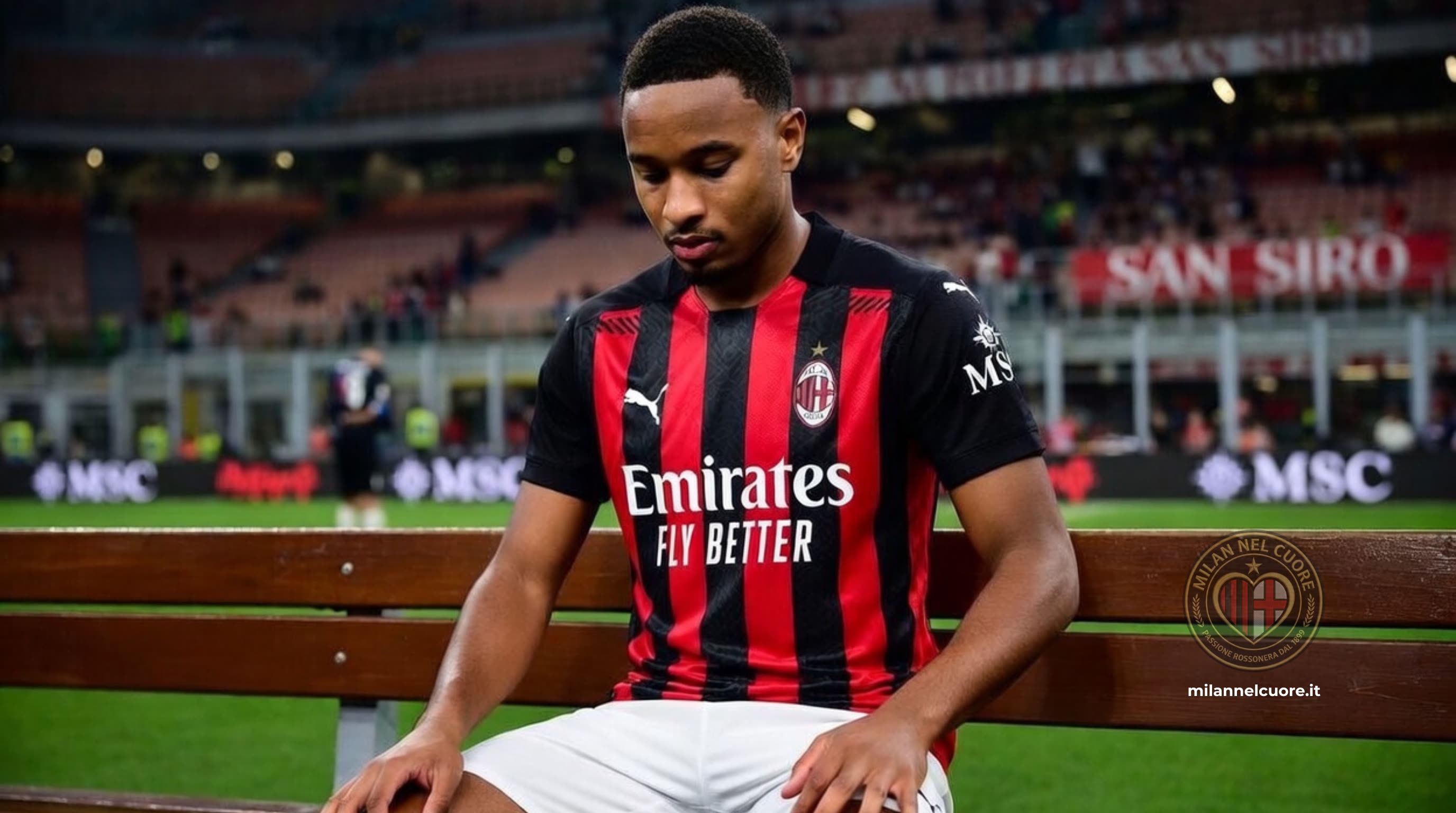
When AC Milan sealed the signing of Christopher Nkunku from Chelsea for €42 million in August 2025, the Rossoneri faithful welcomed the Frenchman as the attacking reinforcement capable of shifting gears under Massimiliano Allegri. Seven months on, reality tells a very different story: just 6 goals and 3 assists in 27 appearances, most of them from the bench, an offensive hierarchy that has progressively pushed him to the margins and a future that looks increasingly far from Milan. The club has made its decision: Nkunku is on the market. Roma, Atletico Madrid and Fenerbahçe have already made enquiries.
The arrival: a lightning deal and sky-high expectations
Nkunku's story at Milan began with a transfer blitz on the evening of 28 August 2025. The deal with Chelsea was wrapped up in under 48 hours: €37 million plus €5 million in add-ons and a 10% sell-on clause, with a five-year contract running until 2030 worth €5 million net per season. The Frenchman chose the number 18 shirt and arrived at Milanello with an impressive CV.
At RB Leipzig, between 2019 and 2023, Nkunku had enjoyed the most extraordinary seasons of his career. Across four Bundesliga campaigns he racked up 172 appearances and 70 goals, with a devastating breakout in 2021/22: 35 goals and 20 assists in 52 matches. In the Champions League he scored a historic hat-trick against Manchester City, becoming the first player in Leipzig's history to do so. Two DFB-Pokal titles and world-class output had convinced Chelsea to invest over €60 million in the summer of 2023.
In London things had not gone to plan: 62 appearances and 18 goals across two seasons, disrupted by injuries and a tactical system that failed to bring out his best qualities. Winning the Conference League and the 2025 Club World Cup could not make up for the frustration of never quite finding a settled role. When Milan came calling, Nkunku saw the chance to relaunch himself in top-level European football.
The early months: flashes of class and plenty of bench time
The start of the season offered glimpses of the Frenchman's potential. Allegri used him primarily as a second-half weapon, bringing him on to exploit his freshness, pace and ability to run in behind. In the Coppa Italia tie against Pisa, the coach handed him one of his rare starts, deploying him alongside Loftus-Cheek behind the striker while Leao and Pulisic began on the bench.
January brought his finest moment: against Fiorentina, Nkunku scored a 90th-minute equaliser with a precise finish that spared Milan defeat, earning the Man of the Match award. A goal that appeared to be a turning point, the spark that would ignite a starring role in the second half of the campaign.
The stat that tells the story
Of his 27 appearances across Serie A, Coppa Italia and the Supercoppa Italiana, Nkunku started just 13 times. On the remaining 14 occasions he came off the bench, often in the final 20 minutes. An average of 37 minutes per match — far too little for a €42 million signing.
Allegri's hierarchy: third choice behind Leao and Pulisic
The real issue for Nkunku at Milan has never been talent — no one has questioned that — but competition. Massimiliano Allegri built his attacking system around two fixed points: Rafael Leao on the left and Christian Pulisic on the right, switching between a 3-5-2 and a 4-3-3 depending on the opponent. In both setups, the space available to Nkunku has steadily shrunk.
The Frenchman is not an out-and-out winger like Leao nor a versatile wide player like Pulisic. His best qualities emerge as a number 10 or a second striker, roles that have no permanent home in Allegri's system. When the coach tried to integrate him into the attacking rotation on a regular basis in October, the numbers began to dip: inadequate pressing, inconsistent running and limited ability to create overloads in high-profile matches.
The final blow came with the return of Santiago Gimenez from injury. The Mexican striker came back on 21 March against Torino and his presence further closed the door on Nkunku, who entered the same match at the 70th minute as a substitute for Füllkrug for just twenty minutes.
The paradox: top scorer in 2026 yet frozen out
There is an aspect that makes the Nkunku saga particularly paradoxical. Despite his limited playing time, the Frenchman is Milan's top scorer in 2026: 6 goals across all competitions with a remarkable ratio relative to his limited playing time. Striking efficiency that was nonetheless not enough to climb Allegri's pecking order.
The coach explained his thinking in a press conference without mincing words: the team's balance comes before individual talent. Leao and Pulisic provide defensive guarantees that Nkunku cannot match with the same consistency. In Allegri's football, built on defensive solidity and quick transitions, a player who does not cover the pitch relentlessly becomes a luxury the side cannot afford, especially in decisive fixtures.
Nkunku's words in February
"I never thought about leaving. Milan is the biggest club in Italy." — he declared in an interview at the start of February. Words full of respect and attachment that today sound like a farewell in the making. The situation changed rapidly in the weeks that followed and the club has decided to entertain offers this summer.
Behind the scenes: two key figures blocked a January exit
The Nkunku question is not new at Milanello. According to SpazioMilan, back in January Fenerbahçe and coach Domenico Tedesco, who had worked with the Frenchman at Leipzig, knocked on Milan's door with a concrete proposal. The move was blocked by two senior figures within the club who opposed a mid-season sale, convinced that Nkunku could still play a role in the run-in.
That gamble has not paid off. Nkunku's output has not improved, his minutes have dropped further and the board has reached the conclusion that a summer sale is the best solution for all parties: for the club, which needs to free up funds for the transfer market, and for the player, who deserves a team where he can play regularly.
Who wants him: Roma, Atletico Madrid and the Turkish option
The phone at Casa Milan has not stopped ringing. According to Sportitalia and confirmed by other reliable sources, at least three clubs have made concrete enquiries for Nkunku in recent weeks.
Roma are the hottest name in Serie A. The Giallorossi are looking for a quality attacking reinforcement for next season and Nkunku's profile, capable of operating as a number 10 or a second striker, fits their tactical needs well. Roma's advantage is the ability to offer the Frenchman a starting role and the shop window of the Champions League, which the capital club are targeting next term.
From abroad, the most interested club is Atletico Madrid under Diego Simeone. The Colchoneros have a long tradition of buying players who have struggled at big clubs and relaunching them at the highest level. For Nkunku, Atletico would represent a competitive environment with the guaranteed game time that Milan have been unable to provide.
The Fenerbahçe trail also remains alive and the Turkish club could return after their January approach. The bond between Nkunku and Tedesco is strong and Fenerbahçe have the financial muscle to meet Milan's asking price. A bid from the Saudi Pro League cannot be ruled out either, although the player, at 28, appears set on remaining in top-tier European football.
Milan's asking price: the Rossoneri want around €35 million to let Nkunku go. Transfermarkt valued him at €32 million in December, a figure that has since dropped to €28 million. The gap between Milan's demands and the market value is explained by the lengthy contract running until 2030 and the €5 million net salary, which weighs heavily on the club's books. Selling Nkunku would save roughly €10 million gross per year in wages and bring in a sum to reinvest in the transfer window.
The balance-sheet impact: the numbers behind the deal
To fully understand the situation you need to look at the financial figures. Milan paid €37 million plus €5 million in add-ons for Nkunku, a total investment of €42 million amortised over five years. That translates into an annual book cost of roughly €8.4 million for the transfer fee, on top of the €5 million net salary (approximately €10 million gross with Italy's growth-decree tax benefits). A total cost of almost €18 million per year for a player who has accumulated little more than a thousand minutes on the pitch.
A sale at €35 million would allow Milan to record a capital gain relative to the remaining book value while freeing up the wage budget needed to finance at least one of the major summer signings already planned by the board. It is no coincidence that Nkunku's name surfaced during the summit at Casa Milan last week, where Allegri, Tare, Furlani and Ibrahimovic discussed the 2026/27 transfer strategy.
What if Hojlund had arrived instead?
Among fans and in the press, one question has resurfaced with force throughout the season. What if Rasmus Hojlund had arrived instead of Nkunku? The debate, reignited by the Gazzetta dello Sport, stems from the knowledge that Milan were looking for a centre-forward last summer, a different profile from the Frenchman.
Hojlund had been linked with Milan before staying at Manchester United and his profile, a physical striker comfortable playing with his back to goal, would arguably have been a better tactical fit for Allegri. But football is not played with hindsight. The choice fell on Nkunku and the board must now manage the consequences of an investment that has not delivered the expected returns.
What happens next: from now until June
Over the final eight matchdays separating Milan from the end of the season, Nkunku will remain part of the squad and could still carve out important moments. The upcoming trip to the Maradona to face Napoli on 6 April will be a test for every player in the group and Allegri may yet need the Frenchman's quality in a battle for second place that remains wide open.
But the writing appears to be on the wall. Milan sit second with 63 points, six behind leaders Inter and nine clear of fifth place. The season's primary objective, a return to the Champions League after a year's absence, is within touching distance. For next season, however, targeted investment is needed and Nkunku's departure is one piece of the puzzle.
Nkunku's trajectory at Milan is proof that in modern football, talent alone is not enough if the fit with the system and the squad hierarchy is wrong. The Frenchman remains a top-level player who can shine again in the right environment. For Milan, his sale represents a chance to correct course and invest where the squad needs it most. Summer is approaching and the Rossoneri transfer window is already in full swing.
Forza Milan, sempre.